
health testing
On this page, we’ve compiled detailed information about the health concerns currently recognized within the breed, along with the screening and genetic testing recommended for breeding dogs. Our goal is to provide transparency about our own breeding program while also helping educate fellow owners, breeders, and puppy buyers about the importance of health testing in preserving the Mudi.
epilepsy
Epilepsy is one of the more significant health concerns currently seen within the Mudi breed, and it is important to acknowledge that no pedigree can be considered completely “epilepsy free.” While some lines may have a higher reported incidence than others, seizures have appeared across a wide range of pedigrees worldwide.
At this time, there is no genetic test available to identify or eliminate epilepsy. Responsible breeding decisions therefore rely heavily on transparent reporting from owners and breeders regarding seizure activity, affected relatives, and health trends within lines. Sharing this information allows breeders to make more informed pairing decisions and helps the community work toward reducing the prevalence of epilepsy in future generations.
cardiac
Heart disease is considered relatively uncommon in the breed, but it is known to exist in some lines. Because certain cardiac conditions can develop or change over time, regular heart evaluations are recommended throughout a dog’s life, ideally on an annual basis. These screenings may include a basic cardiac auscultation performed by a veterinarian or a more advanced evaluation, such as an electrocardiogram (EKG) performed by a board-certified veterinary cardiologist, to monitor for abnormalities including heart murmurs, arrhythmias, and other cardiac concerns.
Cardiac screening is included as part of the Mudi breed requirements for obtaining an OFA CHIC number.
eye health
Inherited eye diseases and ocular anomalies are known to occur within the breed, making regular ophthalmologic evaluation an important part of responsible breeding practices. Annual eye examinations performed by a board-certified veterinary ophthalmologist are required for all breeding dogs and are required to obtain an OFA CHIC number.
It is also important to understand that not all inherited eye anomalies are considered vision-threatening diseases. Some structural variations may have no impact on a dog’s vision, comfort, or quality of life. In these cases, OFA may still issue a passing eye certification under a “breeder option” designation, allowing breeders to interpret the findings within the broader context of the individual dog and pedigree. Ongoing eye testing, honest reporting, and thoughtful consideration of results all play a critical role in protecting the long-term ocular health of the breed.
we highly recommend reading up on the variable eye diseases that can exist in dogs. click on the photo below to be directed to “the blue book” of presumed inherited eye disorders in dogs, sourced information from Diplomates of the American College of Veterinary Ophthalmologists (ACVO).
yearly eye certification is included as part of the Mudi breed requirements for obtaining an OFA CHIC number.

patellar luxation
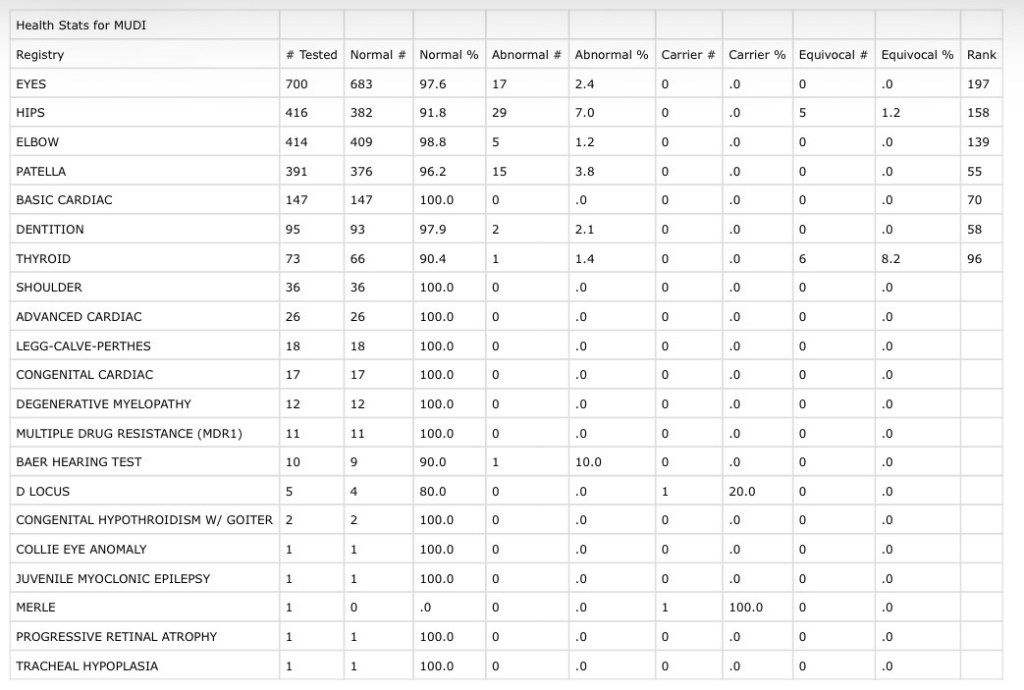
Patellar luxation is an orthopedic condition in which the kneecap (patella) moves out of its normal position within the knee joint. This condition can range from mild to severe and may affect mobility, comfort, and long-term joint health. Some dogs may remain asymptomatic, while others can develop intermittent lameness, gait abnormalities, or discomfort over time. fortunately, patellar luxation is not a large issue in the breed and 96.2% of dogs tested & reported to ofa are clear/normal.
patellar examination is included as part of the Mudi breed requirements for obtaining an OFA CHIC number.
hip & elbow dysplasia
Hip and elbow dysplasia are considered less common in the Mudi compared to many other breeds, but both conditions do still exist within the population and should not be overlooked. Because joint structure plays an important role in a dog’s long-term soundness, comfort, and ability to remain active throughout life, breeding dogs should have their hips and elbows formally evaluated by a board-certified radiologist prior to being considered for breeding. Common evaluation methods include OFA certification or PennHIP assessment.
Fortunately, the breed’s current hip & elbow statistics are encouraging. According to OFA data, approximately 97.6% of tested Mudis received a normal or clear hip evaluation result, and 98.8% received a normal elbow result, which is an excellent reflection of the breed overall. Continued orthopedic health testing and thoughtful breeding practices are essential to maintaining, and ideally improving, these strong numbers for future generations.
hip and elbow evaluations are included as part of the Mudi breed requirements for obtaining an OFA CHIC number.
spine anomalies
Several spinal anomalies have been identified within the Mudi breed, including lumbosacral transitional vertebrae (LTV), spondylosis, and other vertebral abnormalities. While veterinary understanding of these conditions is still evolving, they do appear to be relatively common in dogs in general. Dogs with these findings may range from completely asymptomatic to clinically affected, and severity can vary significantly from case to case.
LTV is generally graded on a scale from 1–4, with increasing complexity and structural involvement at higher grades. Because these anomalies exist on a spectrum, evaluation and interpretation should be considered thoughtfully alongside the individual dog’s overall soundness and health.
The OFA currently offers spinal evaluations through a pilot program; however, these assessments are not considered a simple pass/fail system at this time. For more detailed and consistent grading of LTV, spondylosis, and other vertebral anomalies, many breeders and owners utilize evaluations through INCOC, a Finland-based organization with established expertise in spinal screening.
spinal testing is not required for any pre-breeding screens, but it is a very useful tool in making breeding decisions, as some breeders (including ourselves) do not feel comfortable breeding dogs with these anomalies. We strongly encourage prospective puppy buyers to do their due diligence by asking breeders about spinal screening, requesting proof of testing when available, and discussing the reasoning behind a breeder’s decision whether or not to perform these evaluations.